Showing posts with label Battle of Maida. Show all posts

Sunday, August 10, 2025

Front Rank French Napoleonic 1st Legere

Hello There! I recently heard that the stock market had crashed and that the Earth was threatening to spin out of its orbit. I can only put this down to the fact I recently finished painting some Napoleonic figures!

Unfortunately, in the recent house move, (well nearly a years ago now), the only damages were the newly completed battalion of French Leger, before I was able to photograph them. I have started to repair them and start a second battalion.


First up is the casualty marker. I saw this figure on the web page of Front Rank and thought he would make a suitable casualty marker. I have also made a point of including the white tape around the back pack. Some of the other figures in the unit also include white patches on the back packs as I have discovered that the back packs are made of goat skin and may be in  number of different shades and patches.


These photos are a little over exposed but there was not much light on the day, despite going out side and my make shift light box being attacked by the cat!

There are three more bases for the second battalion under way and two more bases being repaired. These will be done soon.


Thursday, March 17, 2022

Napoleonic Shako Rules Try Out


Hello There! I have been painting Napoleonic 28mm figures for a while now and finally have enough to put on a game.

I have used Shako II rules for many years, at the club I attend, but with a number of people being more familiar with the rules I have never learned the rules thoroughly. This has obviously been a problem when you want to put a game on yourself!


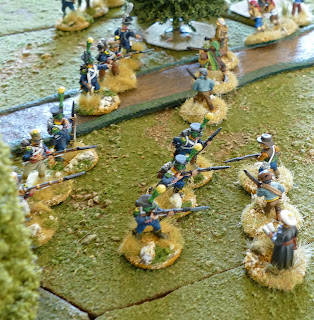
Adrian and I played a thrown together game using all the figures that we had available. This resulted in a mix of Spanish and French on one side and British and Austrians on the other. The scenario was loosely based on Maida but both sides had cavalry at their disposal.   


The steep learning curve nature of the game meant that there was not much time to take photos but here are the few that I did take.


I used the singularly based figures intended for the skirmish rules as skirmisher stands. The Spanish guerrillas stood in for the British allies and the Royal Corsican Rangers and the Sicilian Light Infantry. 


All of these figures were on the table for the first time. Here is one of the Austrian Colonels I have completed recently. 

The battlefield covered 8' by 4' and the scenario provided a good and useful learning experience. After the game we had a few questions for some club members.

The game played out quickly, even with referring to the rule book a number of times.

The French came very close to winning and put a lot of pressure on the defenders for a long time. The French column attacks did not fair well with the dice throws and eventually rebounded and fell back.

The cavalry battles continued for a few moves and then, while they were doing well their infantry forces broke obliging the cavalry to retire.

We found ourselves flicking through the rules a lot and the hap hazard way the subjects are organised made it difficult to find what you wanted to clarify.

I have since contacted some members of the Shako II facebook page and they have been kind enough to send me a list of  the headed titles from the rule book and an edited quick reference sheet showing other house rules from other clubs.

These all provide food for thought for the future.

Wednesday, January 5, 2022

Front Rank French 28mm 42nd Line

Hello there! I have realised that I have completed a second battalion of the 42nd French line but only posted parts of the first battalion completed in the post on making flags for units.


These are based on Shako II rules so are three bases of six figures. The flags are from GMB and the standard was replaced with a brass wire.


The second battalion, at the front, probably did not have bearskins, but they look good on the table!


These are for the Maida refight and I have some French light infantry to do next. 


Friday, April 2, 2021

Battle of Maida

Hello There! I have been painting units to refight the Battle of Maida so have decided to write the British and French orders of battle to show progess on the project.

Here is the French now. After referring to a number of written and internet sources I have found many discrepanicies concerning the number of battalions that some regiments had at the battle. For example the 1st Legere is reported to have had either two or three battalions present while the Swiss had either one or two battalions.


Also the number of men in each unit has not been forth coming as there appears to be many vague total quoted for the whole French force but little on individual units. I have listed the hypothetical figures from a copy of 'First Empire' that I have found on the internet.

French Order of Battle

Commander: General Jean-Louis-Ebenezer Regnier, (Reynier)

1st Brigade: General de Brigade Louis Fursy Henri Compere

1st Battalion, 1st Legere                                                                                            600 men

2nd Battalion 1st Legere                                                                                            600 men

1st Battalion, 42nd Line                                                                                              600 men

2nd Battalion 42nd Line                                                                                              600 men


2nd Brigade: General de Brigade Antoine Digonet

1st Battalion 23rd Legere                                                                                            600 men

2nd Battalion 23rd Leger                                                                                             575 men


3rd Brigade: General de Brigade Louis Peyri

1st Battalion 1st Polish Legion, (1st Polish Line Infantry Battalion)                            400 men

2nd Battalion 1st Polish Legion, (1st Polish Line Infantry Battalion)                           400 men

4th Battalion 1st Swiss Line Regiment                                                                        600 men


Artillery: Commander, 'Griois'

1 Company Horse Artillery 2 guns                                                                                20 men

3 Batteries Foot Artillery 18 Guns                                                                                45 men,

                                                                                                                    (I don't think so!)


Cavalry:

 9th Chasseurs a Cheval                                                                                            300 men


Compere's Brigade

Conflicting sources state this brigade consisted of three battalions of the 1st Legere only while the greater majority of sources state there were two battalions of 1st Legere and two battalions of 42nd Line.

I have chosen to place two battalions of each regiment in this brigade.

The 1st Legere had an extensive experience of campaigning in Italy, during the revolutionary Wars and were present at the Battle of Marengo.

The 42nd Regiment also fought in the Revolutionary Wars in Flanders

Digonet's Brigade

The 23rd Legere were formed in 1792 and had fought in Northern Italy in 1805 and been present at the battle of Caldiero.

Peyri's Brigade

Some sources has placed the 42nd regiments battalions in this brigade. I believe that this  brigade only consisted of the foreign troops in French service.

Again the Swiss troops here are described as either one or two battalions 

The Polish troops are repeatedly described as 'poor and unreliable' in Hopton's book and this was put down to the fact they had been recruited from Austrian prisoners of war.

On their initial contact with the British, while they were landing on the peninsular, 400 of these Polish troops drove back the Corsican Rangers but were in turn pushed back by British infantry.

9th Chasseur a Cheval

The 9th Chasseurs were the only cavalry to take part in the battle. They arrived with further Polish troops and General Digonet on the 1st July. 

Artillery

These are described a 'mountain guns' in Hopton but the calibre is not described. Mountain guns are more easy to transport across the mountainous tertain of the area but lacked the punch of larger calibre guns on the battlefield.

Regnier's force was described as deficient in artillery so I am unsure of the eighteen foot artillery guns present in some orders of battle. However the speed of the advance of the French and the mountainous character of the region may explain why they are not present but the mountain guns are.

Initially Regnier is supplied with two companies of horse artillery and two companies of foot artillery and present at the battle itself were 'four light field pieces' I would say these were four pounders.

The calibre of the guns are described as not larger than the four pounders used by the British.

The total 

5100 infantry

300 cavalry

Sources

The Battle of Maida 1806, Fifteen Minutes of Glory by Richard Hopton

Wellington's Switzers by Alistair Nichols

Scenario: Maida 1806 - Honour Scenarios Wiki (google.com)


Friday, November 20, 2020

British Napoleonic Field Artillery Book

 Hello There! I am continuing with the Maida project which has brought me to painting some 28mm Front Rank British Foot Artillery. After looking at the uniform research sources I had I found myself with a number of unanswered questions about their uniform so after a quick search found the companion volume to this here. 

I found it to be the 'one stop shop' for British Foot artillery, Royal Horse artillery and drivers with many useful illustrations of uniforms, artillery pieces and equipment.

It includes adequate information so I can also build a Royal Horse Artillery limber team complete with the traces and reins rather than just have the models of the horses just standing infront of the limber with no visible means of attachment.

This edition is a soft back and is £10 off the cover price. This is common deal with Paul and he stocks both new and second hand books in his collection which constantly changes. It is definitely worth visiting his website regularly.

This book was promptly sent to me from here.  Paul Meekins books have been a very helpful and a well priced resource for military books. I have used his services for over 16 years now. With the lack of wargaming shows I have not made purchases in person but he did regularly attend 'Salute' and the 'War & Peace' show at Beltring in Kent.

I would recommend both this book and Paul Meekins Books to you.

Wednesday, November 11, 2020

42nd French Line Infantry Regiment

 Hello There! The latest unit to be completed for the 'Maida project is the French 42nd Line infantry.


The battalions I paint are 18 figures strong and are intended for use with Shako II rules. Here the flag is from GMB and the figures are mainly Wargames Foundry with some Front Rank and Perrys in there too.


I liked the officer in the great coat so he was a first choice to put in the central  or command base.


I wanted the unit to look a bit more spectacular and decided to add the grenadiers in bearskins.  
The voltigeurs are in more 'standard' yellow and green distinctions with a few tufts to add to the base.

I have prepped some artillery for the British and chasseur a cheval for the French to be completed next. 


Thursday, October 15, 2020

The Battle of Maida, 4th July 1806

Hello There! I have been painting units to refight the Battle of Maida so have decided to write the British and French orders of battle to show progess on the project.

Here is the British first.

British Order of Battle

Commander: General   Sir John Stuart


Light Infantry Brigade: Commander Lt-Col James Kempt, (formerly 81st Reg commander)

Composite Light Infantry Battalion, (nine companies)

'Flankers' from 35th Foot, (120 men) (possibly part of the Light Battalion)

Royal Corsican Rangers, (two companies)

Sicilian Light Infantry, (one company)


1st Brigade: Commander: Brigadier Sir Lowry Cole

Grenadier battalion, (seven companies) Lt-Col O'Callaghan

1st battalion, 27th Foot, (eight companies)


Second Brigade: Commander: Brigadier Wroth Palmer Acland

2nd battalion, 78th Foot, (eight companies) Commander Lt-Col Patrick MacLeod

1st battalion, 81st Foot, (eight companies)


Third Brigade: Colonel John Oswald

20th Foot, (eight companies) (Veteran, from Egyptain campaign, Distiguished)

1st Battalion, 58th Foot, (eight companies)

Watteville Regiment, (nine companies)


Artillery, Commander Major Lemoine

10 x 4pdr

4 x 6pdr

2 x howitzers, (Calibre?)


Light Battalion

    This was formed while the battalions were in Malta. Lt- General Sir James Craig stripped the other battalions of their light companies and formed a light battalion of nine companies. While in Malta they were trained in light infantry tactics and he encouraged esprit de Corps in the new unit.

       The unit fought well in the battle and was considered strong and reliable.  

    Although this tactic was seldom used by the British and not again after this battle, (according to Oman), the historian described this action as 'an execrable device'. He highlighted the removal of the battalions best shots and removing the light skirmisher screen which the battalion would also benefit from.

      The system was abolished by Sir John Moore, who commanded the army in Sicily after the replacement of Stuart in July 1806.

Royal Corsican Rangers

    Raised in Malta on 14 September 1803 and commanded by Hudson Lowe this unit consisted of ten companies of sixty men each, two companies of which were present at Maida. Spending all their existence in the Mediterranean area they were uniformed in a very similar way to the 95th rifles, (although I do not believe they were armed with a rifle), the only difference being the black cords had an obvious red fleck included in it.

        I will use figures representing 95th Rifles for this unit leaving out the red fleck so I can use them for further Peninsular War scenarios in the future.

This unit is illustrated in Osprey men at arms 335 Emigre and Foreign Troops in British Service (2) 1803-1815 by Rene Chartrand, plateA3

Sicilian Light Infantry

    Raised in Sicily in May 1806 part or all of this unit was present at Maida. Some sources say just one company was present and another says'it' was present inferring it was all present.

    It was barely raised and kept in reserve so could not be trusted in battle.

    This unit is illustrated in Osprey men at arms 335 Emigre and Foreign Troops in British Service (2) 1803-1815 by Rene Chartrand, plate D2

Grenadier Battalion

This was a composite battalion composed of the Grenadier companies from all except the Watteville regiment, hence their extra company compaired to the other battalions.  

Again formed on Malta it provided another battalion for this force and were very accomplished during the battle.

1st Battalion 27th Foot, Inniskillin

This battalion had buff facing which also included buff trousers and turnbacks. They were described as 'Hard biting fellows' according to Lt-Gen Sir Hensy Bunbury, (Head of the expeditions quarter master generals department). Therefore I would consider them veteran rather than line in morale value.

Further information can be found here.

2nd battalion, 78th Foot, (Highland) Ross-shire Buffs

    This was a recently raised regimment which had arrived in Messina in May 1806 and was due to go to Malta to reinforce the Sicilian garrison there. They were considered inexperienced. Their service took them to India later and they did not take part in the Peninsular. Due to this I have found it impossible to source their flags and so have made them myself. In turn as I would lke to use the figures in Peninsular games later I will paint another highland unit and use that instead.

Further information is here.

1st battalion, 81st Foot

    This unit also has buff facings and turnbacks. They spent the vast majority of the time in the Meditterranean. Further information can be seen here.

1st Battalion, 20th Foot, East Devon

The East Devons had yellow facings. They had a long history being a part of the Peninsular War and were with the army at Rolicia, Vimero, Corunna, Vittoria, Pyrenees, Orthez and Toulouse.

    Later they guarded Napoleon on St Helena in 1819 and 12 grenadiers of their regiment bore Napoleons coffin in 1821. 

Further information can be found here.

1st Battalion, 58th Foot, Rutlandshire

    This unit had black facing which leads to a drummer in a white jacket. They were considered inexperienced green troops but previously fought with great distinction in Egypt so this may be undeserved.

This unit spent its time in Messina and had no further part in the Peninsular War.

Further information cen be found here.

Watteville Swiss Regiment

This regiment also had black facing. I managed to source their flags from 'Flags of War' from their 'War of 1812' range. This is because it is one of the few units in the British Army that served in the Mediterranean, Peninsular and Canada. The flag does bear the battle honour of 'Maida' but with the flag being folded on the flagstaff it cannot be seen.

Artillery

How this was divided up has been difficult to ascertain.

There was an artillery reserve of  4 x 6pdr and 2 x howitzers.

Dyneleys Battery of 2 x 4pdr supported the light brigade.

This leaves 8 x 4pdr which I assume was spread evenly between the remaining two brigades.

Sources

Osprey men at arms 335 Emigre and Foreign Troops in British Service (2) 1803-1815 by Rene Chartrand

The Battle of Maida 1806, Fifteen Minutes of Glory by Richard Hopton

Wellington's Switzers by Alistair Nichols

Friday, September 25, 2020

Napoleonic British 58th Rutlandshire Regiment

Hello There! As there is a storm raging outside I decided to give the wargames club a miss tonight but in return I am able to put a few more posts on here.  


I have been working on another feature for WSS magazine and have also used this to complete some more of my Napoleonic units for my collection. My painting table is burgeoning under half finished jobs so I have also cleared the decks abit!


These are 28mm Perry miniatures and complete another battalion for the British forces in the Battle of Maida refight that I have planned. They will also be used for Peninsular games alongside the Spanish I am also painting.


The feature in WSS will cover using some of the colours that wargaming figure painters do not feel very comfortable with. Obviously red is one of them!


Saturday, May 30, 2020

French Napoleonic 1st Legere

Hello there! I have still been writing and painting during this fine weather and here is my latest completed unit.


They are front rank figures  and a GMB flag. These are intended as part of a number of units to refight the battle of Maida. However before you all start writing in I do know they would have been uniformed in the side rise and fall plume. I have one of these figures to act as a casualty marker but these will also be making an appearance in the Peninsular and against 1809 Austrians. Also the company organisation would be different.


I have taken the opportunity to use the pictures for this post as a chance to experiment with my none existent camera skills and feel I have made some little progress, This Colonel makes a fine figure indeed.

I am pleased how the blue finally came out and being a bit patient paid off in the long run, (see my previous post).


Here the grenadier group, in full dress, has come out well too. I am planning to use Shako II rules with some amendments organised between Adrian, my gaming friend.


The command group, with GMB flag and Eagle from Front Rank too retains its folds as I have sandwiched foil between the sides as I folded. I explained how to do this in Wargames, Soldiers and Strategy magazine, issue 101.

Finally the last base. I added the bugler, (cornet?), player as a change. The dead grass tufts came from Great Escape Games, here.

Next up will be a race between an Austrian unit or a British one. Each will contribute to a new feature for WSS about painting Red, Yellow and White.